Clear Lake, Iowa
September 2026
Overtourism Has Become Disrespectful Tourism
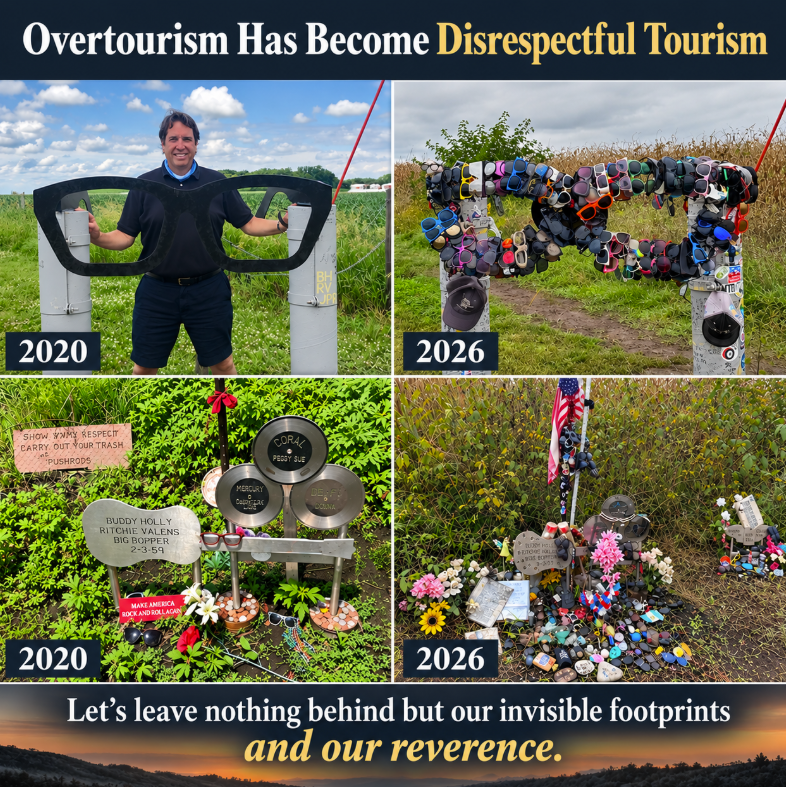
I first visited the Buddy Holly crash site memorial in 2020. It was a quiet, respectful place. I returned in 2026. What I found broke my heart.
Jim PalmeriRead Article →

Travel Expert Column
By Jim Palmeri
Observations from a lifetime in the travel industry — by Jim Palmeri
September 2026
I first visited the Buddy Holly crash site memorial in 2020. It was a quiet, respectful place. I returned in 2026. What I found broke my heart.
October 2026
A hat, a game of darts, and why the best journeys rarely begin with a bucket list.
Clear Lake, Iowa
Jim Palmeri
Travel Industry Expert & Business Engineer · September 2026
I first visited the Buddy Holly crash site memorial outside Clear Lake, Iowa in 2020. It was a quiet, respectful place — a modest marker in a cornfield where three legends of rock and roll lost their lives on February 3, 1959. The Day the Music Died. I stood there, took it in, and left nothing behind but my footprints.
I returned in 2026. What I found broke my heart.
The memorial had been transformed — not by the passage of time, but by the passage of people who confused visiting with possessing. Sunglasses. Hats. Trinkets. Flags. Toys. Stuffed animals. Cans. The site that once honored Buddy Holly, Ritchie Valens, and The Big Bopper with quiet dignity had become a cluttered shrine to our own need to leave a mark.
This is what I call Disrespectful Tourism — and it is the next evolution of the overtourism problem the travel industry has been wrestling with for years.
Overtourism, as we have long defined it, is about volume: too many people in too small a place. Venice. Santorini. Machu Picchu. The crowds overwhelm infrastructure, drive up costs for locals, and erode the very experience that drew visitors in the first place. We know this story.
But Disrespectful Tourism is something different. It is not just about how many people show up — it is about what they do when they get there. It is the impulse to leave something behind, to claim a piece of a place, to make a sacred or historic site about yourself rather than about what it represents.
And increasingly, that impulse is being turbocharged by social media. Instagram and TikTok have fundamentally changed why people travel — and how they behave when they arrive. The goal is no longer the experience itself. The goal is the content. The post. The reel. The viral moment. Travelers are not visiting places; they are producing them.
When a TikTok trend sends thousands of people to a remote waterfall, a hidden beach, or a quiet memorial, the location is not prepared for that volume — and the visitors are not arriving with reverence. They are arriving with a camera and a caption. They leave behind whatever props, decorations, or mementos will make the shot more compelling. The place becomes a backdrop. The history becomes a hashtag.
"Travelers are not visiting places anymore — they are producing them. The goal is no longer the experience. The goal is the content."
The Buddy Holly memorial is not an isolated case. I have seen it at roadside memorials, at national monuments, at historic battlefields, at sacred indigenous sites. The behavior follows a pattern: someone leaves something, others follow, and within a few years a place of meaning becomes a pile of stuff — much of it placed there specifically to be photographed.
There is a sign at the Clear Lake site. It reads: "Show some respect. Carry out your trash. — Pushrods." Someone put it there because someone had to. That sign should not need to exist.
I have spent my career in the travel industry — managing transportation systems for the 2002 Winter Olympics, building group travel networks, working with motor coach associations across North America. I have seen what travel does at its best: it connects people to history, to culture, to each other. It builds empathy. It creates understanding.
But that only happens when travelers approach a destination with reverence — with the understanding that they are guests, not content creators. That the place existed before them and should exist after them, unchanged.
The travel industry has a responsibility here. Tour operators, group travel planners, destination managers — we set the tone. We brief our travelers. We model the behavior we want to see. If we are not actively teaching Leave No Trace principles, if we are not talking about what respectful visitation looks like, we are part of the problem. And if we are quietly benefiting from the traffic that Instagram and TikTok send our way without addressing the damage that follows, we are complicit.
The next time you visit a place that matters — a memorial, a historic site, a natural wonder — ask yourself one question before you leave anything behind, before you set up the shot: Does this honor the place, or does it honor my feed?
Let's leave nothing behind but our invisible footprints — and our reverence.
Jim Palmeri is the founder of the James J. Palmeri Company and a veteran of the group travel and motor coach industry. He managed transportation systems for the 2002 Salt Lake City Winter Olympics and has worked with travel associations across North America.
The American Heartland
Jim Palmeri
Travel Industry Expert & Business Engineer · October 2026
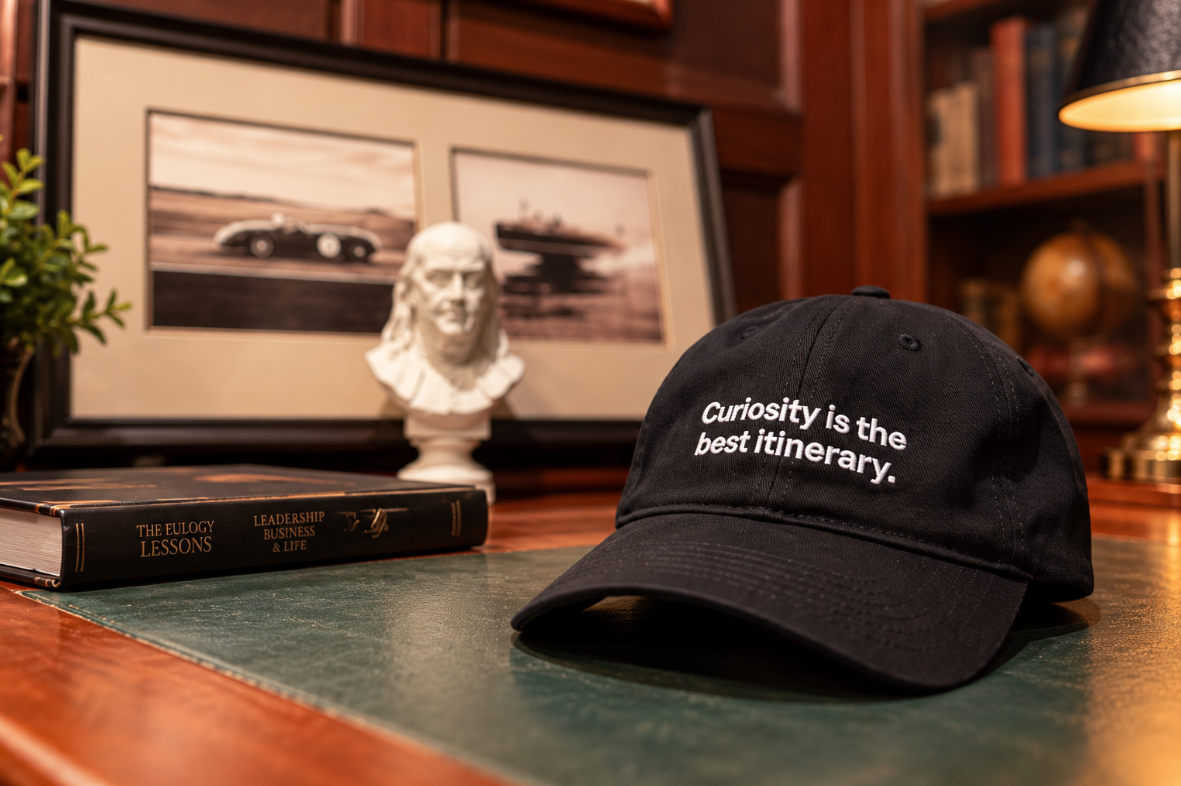
I recently purchased a baseball cap from Lonely Planet, the well-known travel guide company. Across the front were five simple words: "Curiosity is the best itinerary." At first, I thought it was just a clever slogan. But the more I considered those words, the more I realized they offered something increasingly missing from the way we travel today.
It also struck me as somewhat ironic that the hat came from a company called Lonely Planet. After all, there are still plenty of lonely places on this planet. Places where visitors are relatively uncommon, where communities retain their own distinctive character, and where a traveler might discover something extraordinary without standing in line to photograph it.
Yet so much of modern tourism takes us in precisely the opposite direction. We travel to the same destinations, photograph the same landmarks, eat in the same recommended restaurants, and follow itineraries assembled by people we have never met. We call these experiences our bucket lists. But I wonder: Whose bucket list are we really following?
One of my favorite scenes from the television series Ted Lasso takes place in a pub during a game of darts. Ted finds himself competing against Rupert Mannion, a wealthy and arrogant man convinced he can easily defeat him. Rupert makes assumptions about Ted's abilities based on his appearance and seemingly unsophisticated demeanor. What Rupert never bothers to do is ask whether Ted has played darts before.
As the game progresses, Ted recalls a saying often attributed to Walt Whitman: Be curious, not judgmental. He explains that people have underestimated him throughout his life because they were too busy judging him to ask questions. Had Rupert simply asked about Ted's experience with darts, he would have discovered that Ted spent years playing the game with his father. Ted proceeds to win.
We make assumptions about places all the time. We assume Paris must be more interesting than a small French village. We assume Italy's Amalfi Coast must be more rewarding than an obscure town in the country's interior. We assume a vacation in an exotic foreign country must be more memorable than a journey through Arkansas, Iowa, or Mississippi. But how often have we actually asked what makes those overlooked places special?
Somewhere along the way, travel became something of a competitive sport. How many countries have you visited? Have you been to Machu Picchu? Have you photographed the sunset in Santorini? There is certainly nothing wrong with visiting famous destinations. But the problem begins when we allow their popularity to determine our interests.
Social media has accelerated this tendency. Instagram and Facebook present us with an endless parade of beautiful destinations, often photographed from precisely the same angles. Travel influencers recommend their favorite restaurants, hotels, and attractions. Before long, we are no longer discovering destinations. Destinations are being marketed to us. And perhaps most troubling, we begin confusing someone else's curiosity with our own.
According to Expedia's 2025 travel trends report, 63% of surveyed consumers said they were likely to visit a lesser-known, less-crowded destination on their next trip. Expedia even developed a name for this growing interest: Detour Destinations. Research from Booking.com, involving more than 27,000 travelers across 33 countries, found that 67% hoped to use technology to find less-crowded places. Perhaps even more interesting, 44% said they would refrain from tagging the locations of lesser-known destinations on social media to avoid attracting crowds.
One of the great ironies of American tourism is that we often spend thousands of dollars traveling overseas to discover authentic communities while flying directly over equally fascinating places in our own country. We even have a somewhat dismissive term for much of America: Flyover country. But what an unfortunate description for a region filled with remarkable history, distinctive cultures, extraordinary landscapes, and communities with an enormous sense of place and pride.
My wife and I, for example, have made it a personal goal to visit as many Presidential libraries as possible. It's an interest that takes us to parts of America we might otherwise never have considered visiting. Along the way, we discover small towns, local restaurants, interesting people, and pieces of American history that extend well beyond the libraries themselves. The Presidential libraries may be our reason for making the trip, but quite often, it's what we discover along the way that makes the journey memorable.
"Travel should be an expression of our individuality, not a confirmation of what everyone else has already decided is worth seeing."
If I were to recommend one particularly rewarding example of curiosity-driven travel in America, it would be a journey through the communities along the Mississippi River. Not necessarily a luxury river cruise, although those certainly have their appeal. I'm talking about following the river and its surrounding countryside, stopping in small towns, visiting local museums, listening to regional music, and discovering the cultural traditions that developed along one of America's most important waterways.
The Mississippi River is much more than a geographic feature. It is a living history of America. Its communities tell stories of Native American civilizations, European exploration, agriculture, immigration, slavery, emancipation, commerce, literature, and music.
For anyone curious about American music, the Mississippi Blues Trail offers a remarkable opportunity. According to Visit Mississippi, the trail includes more than 200 historical markers, documenting the musicians, communities, and locations that helped shape the blues. Travel through Clarksdale, Indianola, Greenwood, and other Delta towns, and you begin to understand that the blues was not simply a musical style. It was an expression of people's lives — reflecting hardship, resilience, creativity, injustice, humor, and hope.
There is, however, something we need to acknowledge about traveling beyond the familiar tourist destinations. Curiosity sometimes requires us to become uncomfortable. If we want to experience places that haven't been transformed to accommodate mass tourism, we cannot always expect the conveniences of home. The hotel may be modest. The restaurant may have a limited menu. The roads may be unfamiliar, the service slower, and the available amenities considerably different from what we have grown accustomed to.
Yet there is a difference between being unsafe and simply being outside our comfort zone. The most meaningful journeys often require a little flexibility, patience, and humility. Sometimes we need to accept that things are done differently somewhere else. Sometimes we need to listen more than we speak. And sometimes we need to be willing to get lost, figuratively if not literally, before we discover something worthwhile.
Maybe it's time to reconsider the traditional bucket list. Instead of compiling a list of famous destinations we feel obligated to visit, what if we began with a list of things that genuinely interest us? Perhaps you're fascinated by music — follow the Mississippi Blues Trail. Perhaps you enjoy architecture — explore the historic downtowns of the Midwest. Perhaps American history fascinates you — follow the trail of our presidents. The possibilities are endless because our interests are individual. And that is precisely the point.
I keep coming back to that scene from Ted Lasso. Rupert lost the dart game because he never asked the right question. He assumed he already knew the answer. I wonder how many travel experiences we miss for exactly the same reason. We assume certain places are worth visiting because everyone tells us they are. We assume other places aren't worth visiting because nobody talks about them.
Perhaps the next time we begin planning a vacation, we should resist the temptation to immediately search for the world's top ten destinations. Instead, we might ask ourselves a much simpler question: What am I genuinely curious about? Maybe the answer will take us to Paris. Maybe it will lead us down Highway 61, through the Mississippi Delta, into a small-town diner in Iowa, to a Presidential library in the American heartland, or along a quiet road somewhere we never thought to visit.
And if we are willing to sacrifice a few familiar comforts, ask a few questions, and listen carefully to the answers, we might return with something far more valuable than another destination checked off a list. We might return with a better understanding of the world and our place within it.
Which brings me back to that hat. Five simple words that have become a rather compelling philosophy of travel. Curiosity is the best itinerary. And perhaps the best journeys begin when we stop following everyone else's directions and start asking our own questions.
Jim Palmeri is the founder of the James J. Palmeri Company and a veteran of the group travel and motor coach industry. He managed transportation systems for the 2002 Salt Lake City Winter Olympics and has worked with travel associations across North America.